Using Puppet Pals beyond story telling.

I have always been a fan of the Puppet Pals and it was one of the first apps I came across when my journey with iPad began. At BETT 2013 I worked with Ian Wilson ADE again and we had a lot of time to chat about new apps. During the week the Puppet Pals 2 app was released and that was one of the apps we talked about. This addition to the Puppet Pals series makes further use of animation and has some very cool characters which interact with other objects on the set… But we agreed that the simple charm of the original app was what we liked. I have always enjoyed putting in my own characters straight from books, and Ian talked about using the app beyond the obvious story telling purpose.

He explained how he has used Puppet Pals to discuss physics, moving objects (put in as characters) around a plain white background and recording the conversation in the app. Straight away I thought this was a great idea and I knew that when the opportunity came for me to adapt this to an early years context I would pull it out of my bag of tricks…

And the time came to use it…

Continue reading

Getting more from Windows 7 and your Interactive Whiteboard: Gadgets, Widgets and Snipping… #ukedchat #edtech

This half term our school have had new Promethean interactive whiteboards and a priority within the ICT team has been to improve whiteboard use. As I always say, training and sharing is the best way to improve staff skills. So this is the route we are taking.

Here a few ideas, tips and tricks that are easy ideas for whiteboard use. All of them are free, most of them are already installed on your Windows 7 machine!

Continue reading

Transformation in Education: Can iPad help to transform learning?

This has been a very busy half term, as it always is at the end of the year, so I feel that I have neglected my blog. It’s time to update you on what I’ve been doing and how my thinking has been enhanced by the people I’ve been working with recently.
I am very lucky to have a headteacher who values my continual professional development and allows me to work at, and attend, ICT conferences on a regular basis. This half term I feel like I’ve been on tour. I’ve spoken at several events in various counties about iPad and it’s potential in Early Years and Primary education. Bedfordshire, Birmingham, Derbyshire and Nottinghamshire have welcomed me to their events and the feedback I’ve had has been overwhelming.
At an ICT Subject Leaders conference I had the chance to listen to Craig Wilkie who speaks passionately about Transformation in Education. I really valued his honesty, and almost his vulnerability, in promoting this thinking in schools (Transformation sounds like a big deal, and a scary concept!) However, as his presentation went on, I realised that my school and other settings I have worked with are transforming the learning culture.
Wilkie provoked discussion on ICT and how it is playing a part in transforming learning but ICT is only ‘one spoke of the bicycle wheel’. He wanted me to unpick the steps to transforming my classroom and gave me 3 labels to place in order along a line: “Transformation” “Replacement” “Enhancement”.

Continue reading

Technology in the new Early Years Foundation Stage: What do you need to prepare?

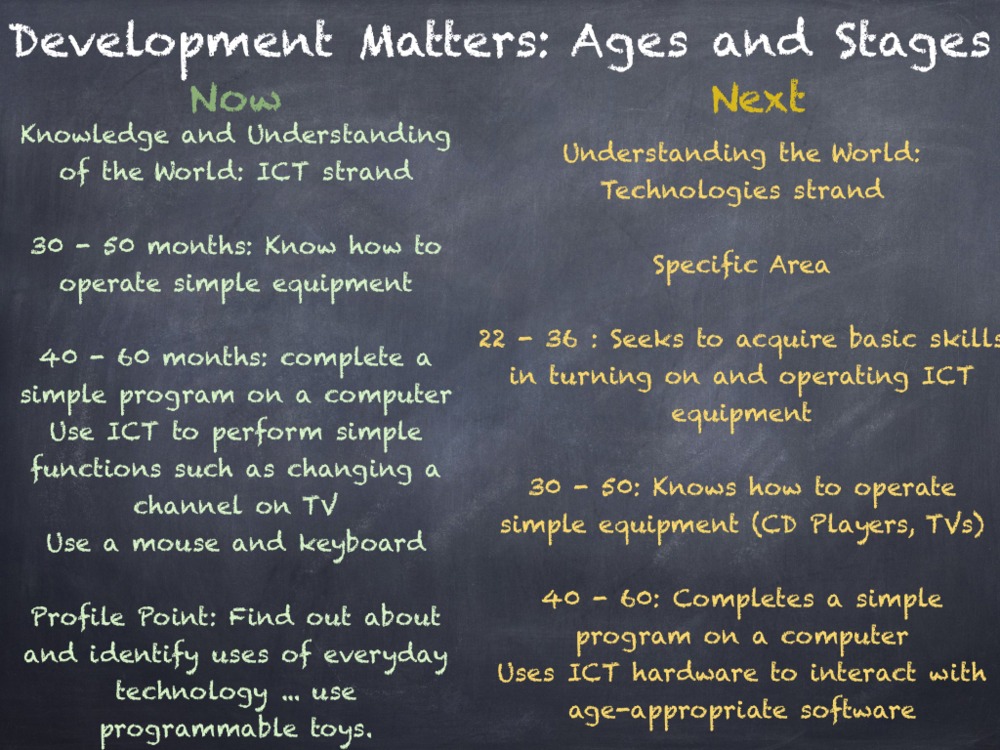
The new EYFS is on the way in September and the Development Matters document is bringing exciting changes across all of areas of learning, but for me, the greatest acknowledgement is in the Technology strand of ‘Understanding the World’.
 
During the Summer Term I have been working in a variety of counties discussing my use of iPad and how I believe this tool has a strong place within the new Technologies strand.So what is happening in Development Matters?
photo_1_1-png-scaled-1000
photo_2_1-png-scaled-1000
photo_3_1-png-scaled-1000
photo_4-png-scaled-1000
Creating Content
  
It seems that the use of a BeeBot, or other programmable toys, is now part of a much wider vision for ICT learning and assessment. The emphasis on using technology in the new curriculum is on children creating their own content. This content creation is embedded in the other areas of learning, using technology to enhance communication, language, arts, maths and literacy. Therefore, the skills of the specific area of learning ‘Understanding the World’ can be practised through prime area strands such as speaking, listening and social development.
 
By using an app like Puppet Pals, children are creating and saving their own content on iPad but are also working in a group, taking turns and talking about the story they are retelling.
Age Approriate Software and Hardware
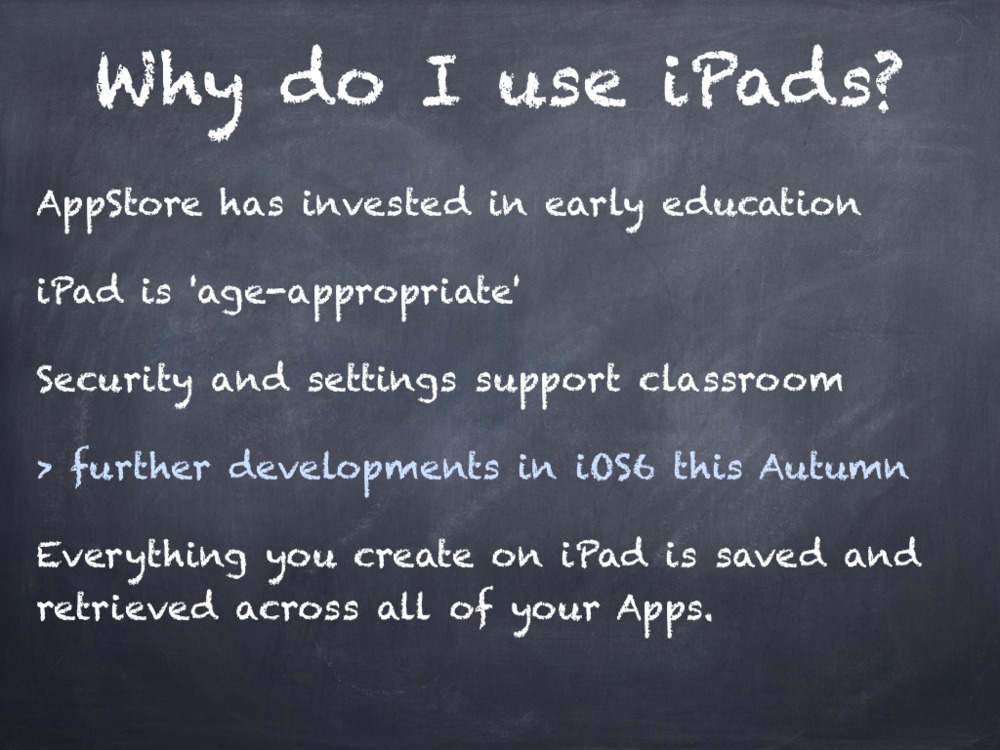
The new strand also mentions the need for selecting age appropriate ICT devices. Many settings and schools use NetBooks, PCs and/or ICT Suites but more settings are turning to mobile devices as age-appropriate solutions. The iPad is an age appropriate device as it promotes sharing and group work as several children can work around one device. It’s touch screen access means that children interact directly with the software and they are learning how to get a response from an animation or display on screen by touching exactly what they want. The fewer transition points in an activity, the faster the pace of learning. With a mouse or keyboard, children need to look down at them and then back up at the screen, this can cause some confusion depending on the task! They do need to learn these skills, but we need to be selective in when this is appropriate to the task at hand. What do we want the children to do when learning a story? I want them to retell the story. How am I going to do? Story maps, story walks, role play masks and costumes, small world play and now, Puppet Pals App can retell the story digitally. My proudest moment came from this app this year, where 3 children retold The Gruffalo using this App, a skill I was waiting to see from them.
iPad, compared to other tablets and devices, looks age appropriate in the layout and organisation. iPad doesn’t have any menus, minimising features, exit crosses, dates, times, calendars etc on the home screen. Therefore children look for the software they want using the large icons. 
The security settings also allow children to access the apps which are appropriate to them, and apps like a web browser, AppStore, iTunes can be disabled for classroom use. The latest version of iOS brings Guided Access in the Accessibility settings. This means that in an early years setting, the teacher can set Guided Access so that one particular app is used in that session, and at other times can have free choice of what apps to use. 
Final Thoughts

The new technologies strand is still very limited in what you are assessing, and this is probably is probably due to the digital divide between settings and homes. With an upcoming review of the National Curriculum, it may be useful to look at skills that can be taught in Year 1 and bring these in to planning for the foundation stage too.

Download Now:

Enabling_Environments_Curriculum.600x600-75Enabling Environments: A Computing Curriculum Beginning in Early Years

This book has been written for the Early Years practitioner or Computing Coordinator of a school looking to further embed the use of technology in their Foundation 1 and Foundation 2 settings. Marc Faulder, an Early Years teacher and Apple Distinguished Educator, provides a complete skills curriculum from 30 months to the Early Learning Goal in this book. Chapters introduce a skills curriculum, the assessment and progression of the skills and a thorough planning document to show how technology enhances learning in all Early Learning Goals.

Download_on_iBooks_Badge_US-UK_110x40_090513

How to organise apps and set restrictions for a primary or early years iPad

Please note that images on this blog reflect iOS 5, however the processes remain the same.

For the Summer Term I am planning to support staff at the primary school I work at with understanding the basics of using an iPad in a primary classroom. This blog post is going to act as a base for all of my advice, so it will probably change over the coming weeks.

For information on managing multiple devices and purchasing app licenses, see my blog post here: https://enablingenvironments.wordpress.com/wp-admin/post.php?post=728&action=edit

I saw a blog post at EdTechLoung.com this Easter holiday which gave a huge bank of recommended Apps for Early Years and Primary Education. The blog post also provided information on how to group these Apps into folders to make the iPad more accessible for primary aged pupils. This reminded me of a very early blog post I wrote when I first launched ‘Enabling Environments’. I shared the challenges and solutions to using 1 iPad in a class of 30 children, and now I feel I have so much more to say about it. If you want to read about deploying multiple iPads in a classroom or school, read this blog post about the Volume Purchase Program and mobile device management.

Continue reading

PhotoBooth and Inclusion in Art.

When working with the staff at Tiny Tots Day Nursery over the Easter Holiday, one of the themes we investigated was how staff working with under 2s could use iPad with their children. We started by talking about what under 2s enjoy and what the staff already provide that is good quality first experiences. This lead the discussion to think about how iPad can be integrated in to a multi-sensory activity with elements of investigation.

Continue reading

Digital Native, isn’t.

“At TeachMeet Nottingham, March 2012, a statement “digital native isn’t” was shared during a ‘TeachMeet 100 ideas’ exercise. The meaning of this was slightly unpicked, and I understood it as an explanation that today’s children do not have a natural ability to use new technologies. The idea that the youngest of children can just pick up a device and use it off the shelf is being observed by Early Years professionals and parents alike. However, this may also be tied in with the assumption ‘they know how to use it because they are not afraid of it’. I think this is where ‘digital native isn’t’ comes in to play. If we take this assumption seriously, it could mean that we don’t see the need to teach children how to use new technologies, such as using iPad because they can demonstrate basic navigation which astounds us! Therefore we may just leave children to ‘get on with it’ because they are familiar with interactive with devices which are shaping the environment. If this is the case, then children might not ever be shown how to search Google (safely) for images of a character from their favourite book.”

Continue reading

TeachMeet Nottingham has launched! #tmnott

Following the success of Tom Barrett’s TeachMeets for the Midlands and Nottingham, I am pleased to be hosting a follow up TeachMeet event for Nottingham and the East Midlands.

photo_3-scaled1000

Sign up for Tickets here

Tom Barrett has been working hard to secure a new home for TeachMeet Nottingham, and has found a venue at The University of Nottingham’s Jubilee Campus (Learning Sciences Research Institute). Tom’s vision for TeachMeet Nottingham is a smaller scale, more manageable event which doesn’t rely on sponsorship or equipment hire. This partnership with LSRI is perfect, and the venue is resourced with state of the art facilities, such as the capability to stream online coverage of the event.

Pete and I are very excited about organising this event and we look forward to welcoming as many teachers and students as possible on the night. If you are a TeachMeet regular, we are challenging you to bring a TeachMeet Newbie with you. This will help to promote TeachMeet as an alternative to Continual Professional Development. Those of you will be attending for the first time will be overwhelmed by the variety of resources, ideas and strategies shared by real teachers in classrooms around the Midlands.

We advise you to bring your smart phone, iPad, tablet, NetBook or laptop along in order to record all of the ideas shared. TeachMeets are rapid and topics move fast with the 7 minute and 2 minute presentations from attendees, so be ready to take lots of notes. If you are on Twitter, you can follow our TeachMeet hashtag before, during and after the event (#tmnott). As the event is streamed live online, you can interact with viewers from around the world and also those in the room with you! Lots of interesting discussion occurs during and after the event so will want to be involved in this, it’s when the best learning happens!

Both Pete and myself understand that in our profession there is a blurred line between work/life balance, and we are aware that this event takes place on a Friday night until 9pm. Please, don’t let this put you off! TeachMeets are now are crucial aspect of our continual professional development and with challenges faced with budgets and workload in school, it is essential that we build our own professional learning networks so that best practises can be shared outside of our Local Authorities and schools.

“After attending, and being inspired at, a number of TeachMeets over the past year, I’ve decided to take part in the organising and running of TeachMeet Nottingham. TeachMeet offers ‘those in the field’ chance to share and evaluate ideas with like minded people in a friendly and relaxed environment. The content of peoples’ presentations are so varied that there will always be something relevant to your own practice. I’ve never left a TeachMeet without my head being filled with ideas and resources to try out with my class.”

 Peter Bevington (@PeteBevington)

Tom Barrett also started the first TeachMeet 100 at the last TeachMeet Nottingham. We will continue this format of sharing. During the event you will be asked to write down simple ideas, advice or resources which have been successful to you as a teacher. This can be anything you have enjoyed using in your class!  These will be gathered on post-it notes and displayed in the room for us all to share at the end (it’s like Twitter, but with paper and pen!)

Please visit our TeachMeet Nottingham wiki to sign up for tickets and we will see you on the night!
Bringing Stories to Life with iPad

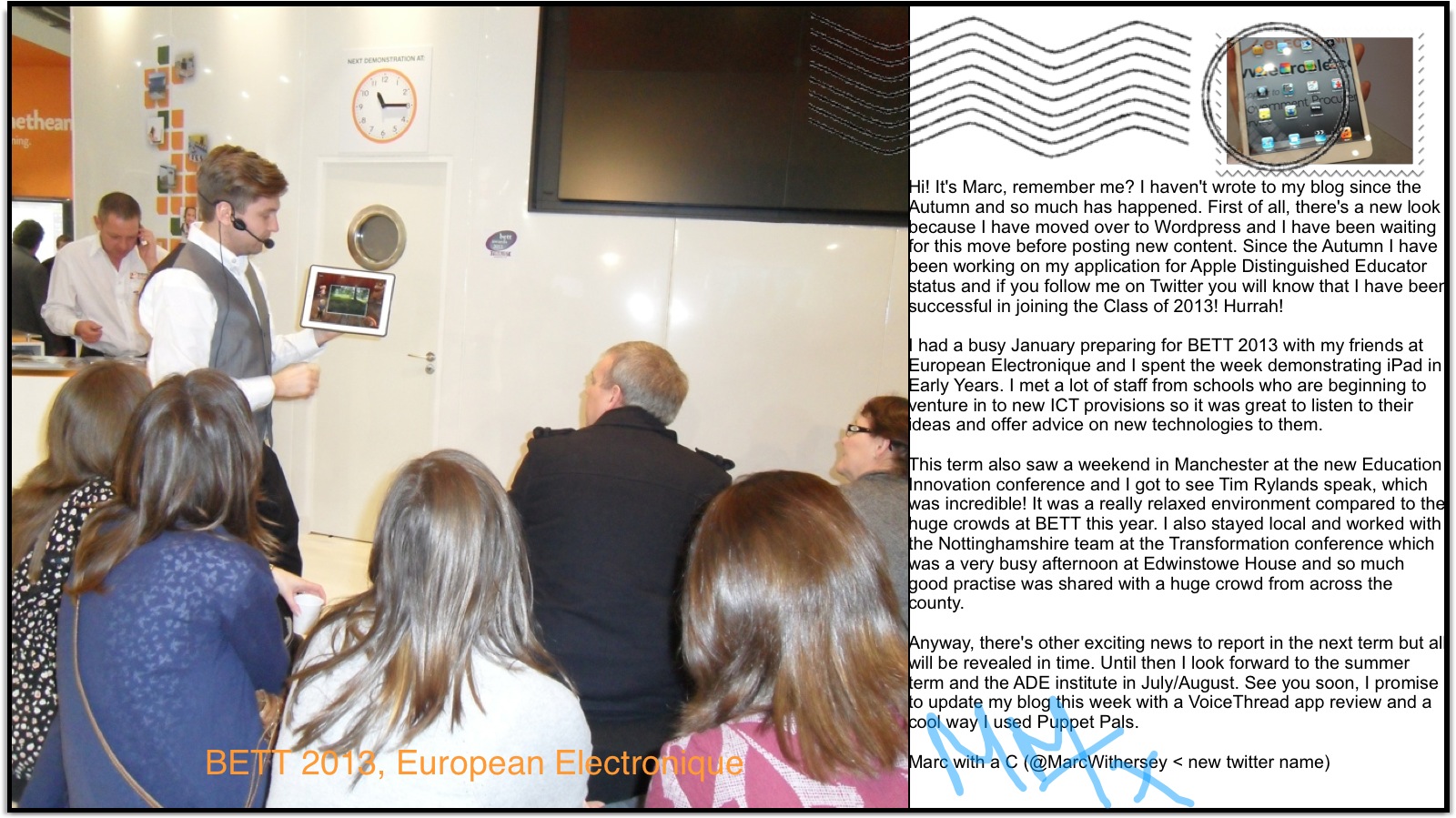
At TeachMeet Nottingham, Friday 30th March, I spoke about my work with Apps Based Learning on iPad and how Puppet Pals and Morpho Booth has been effective in bringing story language to life in my Reception class.

Earlier in the Spring Term 2012, I wrote about the iPad Workshop which I organised at my school with the support of European Electronique (@euroele) and Neil Emery (@neilemerydotcom). Since then I have been busy planning and resourcing opportunities for my Reception class to make the best use of apps in the classroom.

Continue reading